Sunday, October 24, 2010

Beauty and the Machine

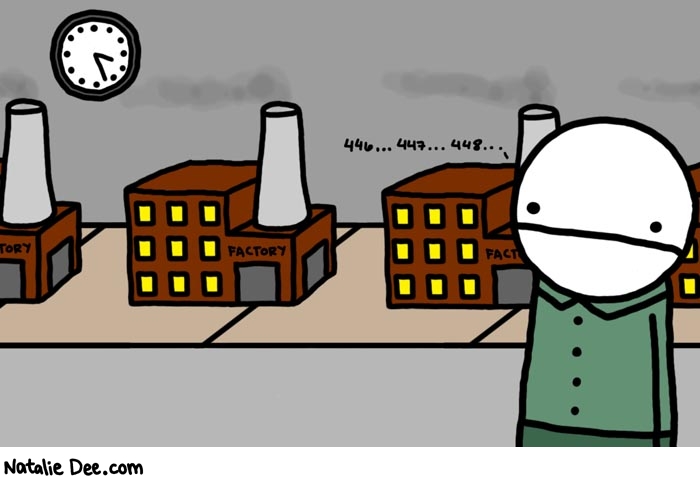
Often times, I try to think how people have come to aesthetically value machines. Aime like Gundam Wing, Volton, and Power Rangers, which took up a large chunk of my childhood's imagination and material desires, point to this interesting fact of human life today. We love machines, but do our machines love us back? If only they could think for themselves like how we do. We are rational. They are only rational in functionality because we made them so, particularly for our own rational interests. Efficiency. Lowered opportunity costs. More freedom through time and money. If we have machines do everything for us, we won't have to do it ourselves. This is the rationale behind technology. When we've reached to a point of maximum efficiency and human freedom, then what is left?

This past weekend, we were able to visit two factories: Hanoisimex and Yamaha. Before arriving there, I was thinking about the last time I was at a factory and I remembered a few years ago having the opportunity to visit the Jelly Belly Factory, which is perhaps a more visitor-kid-friendly attraction compared t these two. And they were; though I can say they depict a clearer sense of reality of labor. Growing up, my imagination around factories was heavily influenced by the Willy Wonka and Santa Claus Christmas parable. These [diminutive] workers, though they do such repetitious labor with machines, they are extremely happy and giddy. Are these oopma loompas and elves actually getting paid? Why the hell are they portrayed as a different species as though this type of labor is not for humans? This type of characterization is the polarized extreme opposite of what is truly reality. My tour of the factory was quite eye-opening and humbling.

I have to say I find beauty in machines, a disastrous kind of beauty.


Couldn't believe the Express shirts I saw were being produced at the same factory with other brands. Doesn't it make you wonder about the legitimacy and realness of brands themselves? Everything nowadays come out of factories, and sometimes out of the same factory.


Tuesday, October 19, 2010

Home This Weekend

While everyone was away at Sapa hiking and hurdling through the mountains, I decided to stay home to rest. As much as I am adventurous, I am also a city boy whose comfort zone is exactlythe city zone. I just did not feel like embracing nature to such an extent this time especially when I am constantly reminded of that experience cutting rice and getting totally wasted inside and out. Blah. While I had planned to stay in on the weekend, I followed through with the plan not because simply on that whim, but by circumstance. I was sick the whole weekend because of the same paralleling reason I was sick from the country-side: alcohol. Blah. For one of the nights, my insomnia also came back. I laid there staring into the darkness. Waiting. Waiting to hopefully fall asleep. Blah.

Although the weekend was somewhat painful inside and out. I was able to catch up with a few friends from home online. Thank goodness I did not have work as well though I did miss my co-workers, especially the one who is sick at home having to miss work for one whole week. I hope she gets better soon. It's not the same without you :( :( :(!

I try to avoid thinking about time so much. The calendar makes me sad. I have a tendency to count down the weeks if not days of how much longer I will be here. It's not much. Less than 2 months left. I decided that I will be going back home right after school is over here. Home as in my family in San Jose. The reason why I came here in the first place was because of family. To get away from family to understand family: whatever notions arise from family; what ever definitions, associations surround family. Studying abroad here I believe was a selfish act for me to "soul search"--to learn more, to tìm hiểu (literally, to search and understand). As much as it was a collective journey, it was also an individual journey. After I am done here in Hanoi, this journey abroad may be over, but this journey to "tìm hiểu" will be a life-long process.

I hope to be back in San Jose before Christmas which is also my birthday to celebrate it with my family. I will be turning 22. From what I hear from my Hanoi friends, people around my age often get married. With plans of more schooling down my road, that definitely is not the case for me.. I hope. Sometimes, life is unpredictable as much as we try to plan so much. We'll see what happens from here.

Stressed about:
-You know who
-Women's Day
-Globalization Final (50% of my grade!)
-History Research Paper
-Project Kiem An
-selling my electric bike!
-tương lai (my future) -- GRE, grad school, job searching, oh gawd

If stress is the antithesis of vacation, I guess I am living up to my expectation. Vietnam is not a vacation. Vietnam is not a vacation. Vietnam is not a vacation.


Tuesday, October 12, 2010

Once in a Thousand Years

Once in a thousand years will you be able to witness this celebration of a millennium (though its temporal accuracy could be contested). Once in a lifetime will you be able to study abroad in Vietnam as an undergraduate. This weekend was filled with "once in a lifetimes," and I wonder how these memories of me here will translate in my next few years. All the friends and even family I am making or (re)searching here; all the habits I am developing here and pet-peeves; all elements of my life situated in people's (ordinary) lives here.. I wonder how it will exist in my mind when I get back to the US.

I can't help but to think abstractly after this weekend because this weekend was abstract just like the traffic, the various accidents which included the explosion resulting in 4-12 deaths and numerous accidents on the road, the storm killing many people in the central region, and the meaning of all this craziness. It was a big party, but as a result of any large celebration of indulgence in pleasure and escape, there is definitively no escape from the trash and baggage that will left behind. Just like any large rave, there will always be that rubbish riding behind.

I can't believe I have only 2 months left here. The trip to the south is also in 2 weeks, and after that there will be only 1 month of school and the program left. Back to suburban sur-reality.

As much as I don't want think about the reality of this dream in Vietnam, I do. I do. I do. I can already imagine myself crying the days before departure. I will hold onto those marks I left here in Vietnam, and then I would have to let go. Never will I forget. Perhaps I will return next time, or even more. Perhaps. Let's hope we reunite once again. Past the Cold War politics. Past war.

Tuesday, October 5, 2010

Rice Cutting - cắt lúa

This past weekend, we had the opportunity to go to the countryside though very close to the city-side to get a taste of how city people, or the larger society are able to get a taste of rice everyday. To put simply, we harvested rice that weekend. Gerard's little lesson-plan inserted into EAP's curriculum reminded me of the effects, especially on the policies after communist revolutions throughout history in which the bourgeois were forced to go to the rural areas and contribute to the collectivization of agriculture process. I felt we as (sub)urban dwelling students fell exactly under Gerard's lesson of getting us to appreciate the fact that we have food period. It's definitely a lot of hard work to get a bowl rice. That was what was running through my mind that day, standing in the spider-and-crab-infested mud.

While I was in that field, bare-footed and to a certain degree, bare-minded, I tried imagining a life doing work like this everyday. I tried thinking about the slaves in the so-called "New World." I tried thinking about how food today is incredibly engineered chemically to maximize profits for companies, and what kind of methods other farms and farmers use to process food. I tried thinking about where my family came from generations ago. Perhaps my family members from generations ago were not always city-dwellers. They came from a landscape and a life like this. I wondered to myself how and why has a life and scenery like this been left in the dust of modernization and development? Without this, these people, this type of work, and the struggle, or cực khổ, we would be nothing; we would have nothing. No food, no family. Nothing.

Although I was somewhat conscious of this, I could not help but to think about the latest frontiers like.. what new mail do I have today in my e-mail? or. what kind of notifications do i have today for facebook? It's amazing how much the internet today has affected people's psyches, including mine. Truly, this was the most ironic part. I can be considerably mindful, but at the same time, hypocritical. A city-mind, university-educated, yet not universally-educated.. It's easy to think one way, but it's hard to do another. There was much to think about in terms of this experience, but I think I will leave it at there.


Tuesday, September 28, 2010

Châu [Trung] Sơn - Central (Miền Trung) Trip Reflection

The trip to the central opened up a whole new window Vietnam for me as well as another mirror to understanding closer, yet further the genealogy that is associated with how I ethnically, culturally, and nationally identify myself. While I was overhearing conversations with other EAP’ers whose families hometown is in the south, I related to a lot of their sentiments on how much more they can connect to this region—the people, the food, the way the Vietnamese language is spoken, the mannerisms, etiquette, and so on—unlike their experiences in Hanoi. I found myself aligning with what was discussed.

There, I felt more comfortable and confident speaking Vietnamese. I noticed how much I started to sound like my mother and father when speaking to the locals. I could finally feel that natural vibration in my throat as I pronounce words without being so conscious of imitating the northern accent. It was then that I decided to not forge the northern accent in my articulation. Instead of displacing my family’s tongue, I should try to continually improve it no matter what northerners may think. My family is from the south; Long Xuyen; in a small town called Thot Not. I should speak how people in Thot Not speak.

But ironically, as I started to become more regionally and identity conscious, I started to further question of what constitutes me and to what extent do I romanticize whatever is “ethnic” about me from the beginning? While I am indeed learning if not relearning who I am, or who and what my family is, I am somehow caught in between the rifts of time and space. I suppose after being exposed and interacting with local youth in Hanoi and experiencing the central trip as a tourist opened my eyes to a reality of change. For example, when I hear the word “Vietnamese culture," instantly an image of my family is evoked in mind. I am starting to understanding that Vietnamese people in Vietnam indeed is not my family per say in part because of how generations progress and change. Culture is fluid. Identity is fluid. Just as my family and I are fluid. However, I do have a tendency to preserve what I think my family is in a glass case in my cognitive museum like how I preserve my belongings in my own room.

While I acknowledge my position as an essentially a tourist with a Vietnamese or Asian guise, I constantly reminded myself that Vietnam is not my playground; that I am here to learn first and foremost. Whatever is entailed in the learning is ultimately up to how I choose use my time here.

Viet Kieu. Tourist. Foreigner. I am an American, but my roots are in Vietnam though my umbilical cord is not. Home seems far away, yet I am here. I am here. Then I am there. A few more months left. How will I feel?

Tuesday, September 14, 2010

Pointing Out Poverty

While I was trying to search for food places at 1 AM on a Saturday night, I was invited by the gatekeepers of D11 to eat a midnight meal: instant noodles. While I had these questions in mind, they were ones to first bring up the issue of poverty and what is entailed when a person is poor in the city versus rural. As we were talking about transportation in a thành phố, one person brought up how it's incredibly expensive to buy a car in Vietnam in comparison to the US. Say a car costs $20,000 in the US, the same car would be $40,000 or more in Vietnam. Same goes with Iphones; it may cost $500 in the US, but in Vietnam it would be $1,000 or more. Then they talked about class and social inequities in Vietnam.

"In Vietnam, you either have very rich people or very poor people, there is no middle"

When this was said, the word "development," and words relating to it: globalization, neoliberalism, capitalism, free trade, free market, and so on kept on resounding in my mind. Is this a side effect to what we call progress or đổi mới?

Moreover, many of the gatekeepers told me their home is in more of the country side or less populous city areas.. thành thị. It makes me think again how the flows of capital to the city parallels the migration to the city for jobs as large corporate enterprises take over farmers' lands. Truly, cities all have a kind of parable that comes with it in order for it to legitimate itself. This legitimacy can come through a kind of romanticization as so many movies take place in the city. We did not talk about poverty so much in different areas, but we did touch upon the polarization between rural and urban. One gatekeeper mentioned how poor people in the rural areas are much poorer than the poor in the city though many poor in the city are those who came from the rural areas from the start.

After the weekend, in the beginning of the week, I started working at Bò Sữa or Boo Skateboards in Old Quarter -- www.bosua.vn. The customers we get range from foreign tourists to incredibly rich, and điệu rich people. You can tell they are incredibly rich because most, if not all of them drive Vespas and have tons of make-up on and perfume if they are girls. We rarely get "ordinary"--người bình thường-- people though we get local Vietnamese youth at times. I just thought my experience thus far working here is relevant to the discussion of poverty and wealth. It is also amazing to see this company or công ty be operated by people all under 30, especially when the owner is a little older than 30. Makes me wonder about the future of Vietnam as these Vietnamese entrepreneurs are so avant-garde or "progressive" in that regard. Of course, it all takes place in the city.

"Everything is fair when you're living in the city" - Funkadelic


Tuesday, September 7, 2010

Week 3 - Working to Live, Living to Work


This week team cucumber was able to interview a manager for a refrigerator company. This interview was also our first interview so most if not all of us were trying to get used to carrying out specialized roles during the interview. We were able to interview our interviewee at S-Club over dinner though only a few of us were eating. The manager is young and only 2 years out of college. In many degrees, this interview helped me think more about my own future after undergrad which is only a mere few months away.

Before we conducted the interview with him, team cucumber had a meeting to discuss the rationale for this project to get all the members on a common ground and direction. We read in our notes that the purpose of this project is to inquire on the multi-dimensionality of life in Ha Noi as work is a significant part of human life here. When I read the Gerard's proposed purpose I thought to myself how work is essentially not only a very large part of human life in Hanoi specifically, but human life in general as much as Western thought seeks to separate spheres of life in motion into categories (ie: work life, public life, private life, etc.)

From what I've observed from the village-like settlements in Ha Noi, home, work, family, friends, and customers are often not separated from one other spatially and socially. This contention of what constitutes human life, especially "modern human life" always brings me back to the question of whether life "here" which is perhaps "less modern" better (or will bring you more happiness) "there" in the US. The US may have "efficiency" and more advanced technology, but how happy are people in the US compared to people in Vietnam? Is what you call "development" actually "development"; if so, for who? and what is the meaning behind moving forward? Who or what dictates spatial and temporal direction in the first place besides rationality that is induced by science or the constant human struggle to discover truth, to always outdo what the human mind and body is bounded by-- and that is itself.


To my surprise, our interviewee loved his job because he expressed that his forte is management considering that he studied Tourism and Management," a major of which is popular among many HANU students. Although it may be stressful at times, he emphasized his philosophy on "human improvement" which perhaps implies a progressive-oriented way of thinking. He is always trying to improve himself and help improve others around him; those others are people who he manages. He states that his work is contingent upon the clock. He works 12 hour days and he understands that within the 24 hours of the day he does not necessarily get much "time to himself" besides sleep. For lunches, he is restricted to a time slot and time limit.


This corporate-factory ethos reminds me of when I worked at McDonald's and Macy*s. You time in, and when you're done working, you time out on a machine. My pay was precisely calculated on this machine. Say if I were to time out 20 min early, I would get deducted the pay for 20 minutes. Humans and machines work along and with each other.

After the interview was over, I was enlightened and intrigued by the interviewee's knowledge and passion for his work in a corporate sphere. I knew that as we gradually progress in our project and conduct more interviews, my perception and understanding of Ha No will continue to open up.